
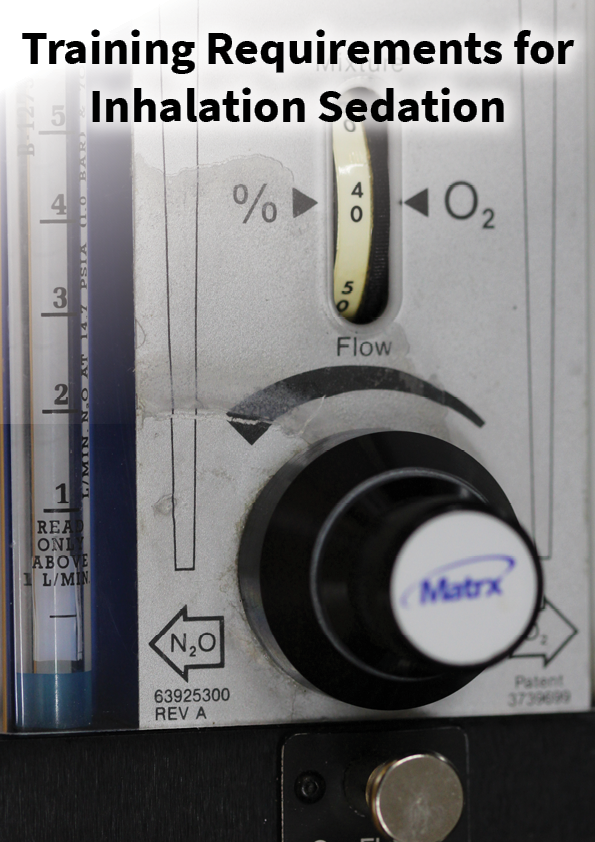
This guide summarises the training requirements for clinicians and dental nurses delivering inhalation sedation, the syllabus that should be covered, and the ongoing CPD needed to maintain competence. It is intended as a reference for practice owners, training leads, and individual practitioners planning their CPD.
What you'll learn
- Understand the theoretical syllabus expected of sedation-trained clinicians and dental nurses.
- Identify the practical competencies that should be demonstrated and signed off.
- Plan an annual CPD programme that maintains competence and meets GDC requirements.
- Recognise when additional training is needed following a critical incident or extended break.
A clinician providing inhalation sedation in the UK should have completed:
- A postgraduate certificate, diploma or MSc in conscious sedation, or equivalent.
- A period of supervised clinical practice — typically a minimum of 10 cases under the direct supervision of an experienced sedationist.
- Annual CPD in conscious sedation — the GDC recommends a minimum of 10 hours per year for those providing sedation, with at least some of that time spent on hands-on or simulation-based training.
- Current training in immediate life support (ILS) or equivalent — refreshed annually.
The 3rd edition of Conscious Sedation in Dentistry (June 2017) revised Section 2.1.1 to include "manufacturer recommended user maintenance, infection control and equipment checks" as part of the clinician's responsibility — so practical equipment training now forms part of the expected syllabus.


A dental nurse assisting with inhalation sedation should:
- Hold a Certificate in Dental Sedation Nursing (or equivalent) from a GDC-recognised provider.
- Be competent in pre-use checks of the inhalation sedation machine.
- Understand the role of the second appropriate person — present throughout the procedure, monitoring the patient, and able to summon help in an emergency.
- Have current training in basic life support (BLS) — refreshed annually.
- Have current training in immediate life support (ILS) for nurses acting as the second appropriate person for higher-risk cases.
In the UK there is no dedicated textbook for inhalation sedation. The information has to be drawn from several sources, including:
- Basic Guide to Dental Sedation Nursing (2011)
- Sedation in Dentistry (1998)
- Practical Conscious Sedation (1st ed. 2004, 2nd ed. 2017)
- Handbook of Nitrous Oxide and Oxygen Sedation (US publication, excellent practical reference)
R A Medical offers in-practice CPD training days for dental teams — call 01535 652 444.
The theoretical syllabus expected of a sedation-trained clinician or nurse covers:
- Anatomy, physiology and pharmacology relevant to sedation.
- The pharmacology of nitrous oxide and oxygen.
- Patient assessment — including ASA classification, airway assessment, and recognition of higher-risk patients.
- The principles of conscious sedation, including the difference between conscious sedation and deeper levels of sedation.
- The practical use of the equipment — pre-use checks, titration, monitoring, recovery.
- Complications and their management — over-sedation, respiratory depression, nausea, vomiting.
- Scavenging and occupational exposure.
- Medico-legal aspects — consent, record-keeping, scope of practice.
- Teamworking — the role of the clinician, the dental nurse, and the second appropriate person.
This list is the minimum. Practices offering sedation should document the training each team member has completed and review it annually.
Practical competencies that should be demonstrated and signed off include:
- Pre-use check of the machine (per manufacturer's checklist).
- Connection and disconnection of the breathing system.
- Titration of nitrous oxide to clinical effect.
- Monitoring the patient throughout the procedure.
- Management of over-sedation, including delivery of 100% oxygen and basic airway management.
- Recovery and discharge.
- Decontamination of the equipment between patients.
Most training programmes include a logbook of cases — typically 10 supervised cases for a clinician new to sedation, fewer for those with prior experience.

Sedation is a GDC-priority area for CPD. The GDC expects:
- A minimum of 10 hours per year of verifiable CPD for clinicians providing sedation.
- A proportion of that CPD to be hands-on or simulation-based, not just didactic.
- A personal development plan (PDP) that identifies the team member's training needs and how they will be met.
- An annual review of competence, with additional training triggered by any critical incident or extended break from clinical practice.
R A Medical runs CPD-accredited training days in the UK — covering both the theoretical refresher and the hands-on equipment updates. Call us on 01535 652 444 for the current schedule.
Key takeaways
- Clinicians providing sedation need a postgraduate qualification plus supervised practice and annual CPD.
- Dental nurses assisting with sedation need a Certificate in Dental Sedation Nursing and current BLS/ILS training.
- The 3rd edition of Conscious Sedation in Dentistry (2017) added equipment maintenance to the syllabus — practical training matters.
References
- Society for the Advancement of Anaesthesia in Dentistry. Conscious Sedation in Dentistry, 3rd edition (2017).
- General Dental Council. Scope of practice and CPD requirements.
- Department of Health (2003). A Conscious Decision. DH, London.
Originally developed as a sponsored educational supplement in Dental Nursing magazine. Re-published by R A Medical Services Ltd with all third-party branding removed.


